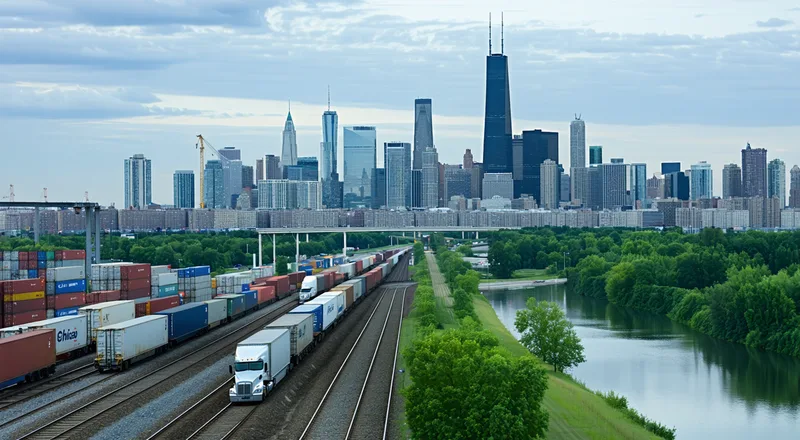
If you've spent any time in freight brokerage, you already know Chicago is the center of gravity for US trucking. What's less often articulated — and worth understanding precisely — is why that's the case, and why it isn't changing in any meaningful way despite the ongoing shifts in population and manufacturing geography that have reshaped other parts of the US economy over the past two decades.
The answer isn't about history or inertia. It's about infrastructure density and the geometry of North American freight flows.
The Rail Intermodal Foundation
Chicago's position in the North American freight network is fundamentally a rail story that predates the interstate highway system by more than 80 years. The city developed as the convergence point for six Class I railroad systems: Union Pacific, BNSF, CSX, Norfolk Southern, CN, and Canadian Pacific. Each of these railroads built or acquired substantial terminal infrastructure in and around the Chicago metropolitan area, and over time that infrastructure calcified into a permanent network advantage.
The modern expression of that advantage is intermodal freight — containers moving from one transportation mode to another, typically ship-to-rail or rail-to-truck. The two largest intermodal terminals in North America, BNSF's Logistics Park Chicago in Elwood and Union Pacific's Global IV facility in Rochelle, are both within roughly 50 miles of downtown Chicago. Combined, these facilities handle an enormous volume of container traffic moving between West Coast ports, inland distribution centers, and East Coast markets. Much of that freight needs to be drayed by truck from the intermodal terminal to its final destination, and that drayage market is concentrated in the Chicago metropolitan area.
For freight brokerages, the intermodal connection matters because it drives consistent truck demand in the region. Drayage loads — short-haul, high-frequency, relatively predictable in volume — are a reliable base of business for brokerages with carrier networks covering the Elwood–Chicago–suburban corridor. That base demand persists even when the broader spot market softens, which gives Chicago-area brokerages a more stable revenue floor than counterparts in markets that are more dependent on manufacturing or agricultural cyclicality.
The I-80 and I-90 Corridor Effect
Interstate 80 is the primary east-west freight corridor across the northern half of the continental United States. It runs from New Jersey to San Francisco, and its Illinois segment connects Chicago to the Iowa border, where it continues west toward the Inland Empire and the Port of Los Angeles. Interstate 90 runs east from Chicago toward Cleveland and Buffalo, connecting to the Northeast manufacturing and distribution markets. The intersection of these two corridors in the Chicago metropolitan area creates a concentration of truck traffic that has no equivalent at any other inland point in the country.
The I-80/I-90 volume also shapes carrier availability. Asset-based carriers running dedicated freight in the Midwest tend to structure their lane networks around Chicago as a hub — positioning equipment here because outbound loads are reliably available. That carrier density, built on decades of freight flow patterns, makes Chicago a uniquely good market for freight brokerages that need to find capacity quickly. A load posting from Chicago to a major Midwestern distribution hub — Columbus, Indianapolis, Kansas City, Memphis — will typically attract multiple carriers within hours on DAT or Truckstop.com because carriers in the area already know those lanes and have trucks positioned for them.
The Freight Brokerage Ecosystem
The concentration of freight brokerage operations in Chicago isn't accidental — it was built on top of the transportation infrastructure. Multiple national third-party logistics companies have established major operations here over the past 30 years, and that concentration created a talent ecosystem: experienced dispatch managers, carrier relationship leads, TMS specialists, and freight pricing analysts who build their careers in Chicago and often stay in the region as the industry evolves.
For a startup building freight technology in 2024, that talent concentration matters. The operational expertise needed to understand why a matching engine needs to handle reefer lane constraints differently from dry van — or why tender acceptance rates on the Chicago–Dallas corridor behave differently from the Chicago–Atlanta corridor — exists in concentrated form in Chicago in a way it doesn't in most other US cities. Tech founders who want to build tools that work for actual freight brokerage operations benefit from being in the same city as the operations they're trying to improve.
This is worth naming directly: we built Loadwyre in Chicago because freight brokerage is genuinely a Chicago industry. Not in a branding sense, but in the practical sense that the people we needed to learn from, test with, and hire from are here.
The Produce and Perishables Factor
Chicago's position as a freight hub isn't just about manufactured goods and intermodal containers. The city is also the distribution center for a significant portion of the fresh produce moving into the Midwest from California, Florida, and Texas growing regions. The Chicago produce market at 2828 South Halsted — one of the largest wholesale produce facilities in the country — drives substantial reefer freight demand across the metropolitan area and connecting lanes into the upper Midwest.
Reefer lanes out of Chicago toward Minneapolis, Detroit, and St. Louis have load patterns tied to produce seasonality in a way that dry van lanes don't. Spring and early summer demand for reefer capacity on these lanes can tighten quickly, and brokerages without established reefer carrier relationships on those corridors get caught short when the seasonal crunch hits. This is a localized version of the broader capacity drought problem — predictable in timing, manageable for brokerages with the right carrier data, but consistently difficult for brokerages that treat reefer and dry van capacity as interchangeable.
What Hasn't Changed and What Has
The fundamental geometry of North American freight flows — shaped by the rail network, the interstate highway system, and the distribution center infrastructure built around both — hasn't materially changed and won't in any short-to-medium horizon. The intermodal terminals in Elwood and Rochelle are permanent infrastructure with multi-decade depreciation cycles. The I-80 corridor is a fixed geographic feature.
What has changed is the technology layer sitting on top of that infrastructure. Load boards have moved from fax machines to web platforms to real-time APIs. TMS systems have gone from on-premise to cloud-hosted. EDI transaction volumes have grown as more carriers adopt electronic tendering. The underlying freight flows are the same; the speed at which brokerages can match loads to carriers has accelerated significantly, and brokerages that haven't updated their matching workflows in the past five years are operating at a real speed disadvantage relative to competitors who have.
The Chicago freight ecosystem is mature and competitive. The brokerages that are growing in it are the ones that have combined the relationship depth of the traditional Midwest freight culture with the data and automation tools that make that relationship depth actionable at higher load volumes. That combination — deep carrier relationships plus systematic matching — is the competitive configuration that the market is moving toward, regardless of how the broader supply chain technology landscape evolves.
Why the Geography Argument Still Matters for Technology
Some conversations about freight technology treat geography as an afterthought — as if a load matching platform should work equally well everywhere, and regional focus is just a marketing choice. That's not quite right. Carrier networks are geographically structured. Preferred lane data is corridor-specific. Seasonal capacity patterns are tied to specific agricultural, manufacturing, and consumer cycles that vary significantly by region.
A matching engine that's built and tested on Chicago corridor data — the I-80 dry van market, the Chicago-to-Nashville reefer lane, the intermodal drayage market around Elwood — will have better calibrated scoring on those lanes than one trained on generic national data. That lane-specific calibration matters most when the market is tight and the difference between a good match and a marginal match is the difference between covering a load at target rate or paying a premium to a carrier who knows you have no alternatives.
That's why we're not pretending our Chicago location is incidental. It shapes what we build and how we calibrate the matching logic. The Midwest freight market is where the carrier density, the lane volume, and the operational expertise are most concentrated — and building here means building with that context in the room.